
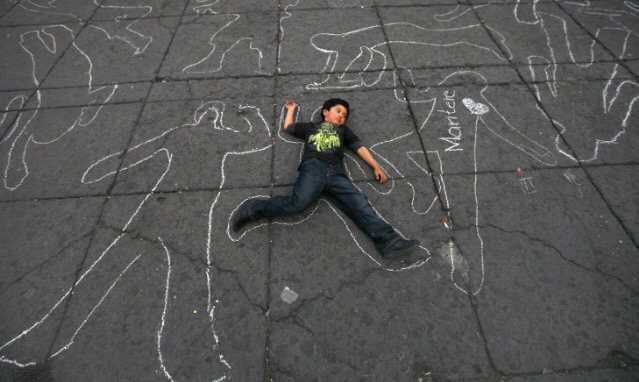
Since the commencement of the Mexican drug war in 2006 led by president Felipe Calderon, there have been over 80,000 people murdered from organized crime in the capital Mexico City (Karimi and Jones). With more than 20 million inhabitants in the capital city, it was estimated that from 2007-2014, more people had died from the drug war than the total amount killed in Afghanistan and Iraq combined. If these statistics weren’t shocking enough, did you know that in the first 9 months of 2011, nearly 13,000 people were also killed from the drug war? (Karimi and Jones) Consequently, Mexico City is considered a dangerous place due to the mass disappearances and killings that occur daily. Shootings have become a normality with 55% of all killings linked to drugs which unfolds the question, why does North America continue to contribute in the war on drugs knowing that thousands of innocent civilians die every day?
This was a devastatingly harsh reality for Israel Castillo who I had the pleasure of listening to in one of my university courses. The violence that takes place daily eventually lead him to escape the corrupt government and life-threatening ordeals of the drug cartels that captivate the streets of Mexico City. Before the war began, Castillo and his family lived happily and safe until the number of shootouts increased and the fear of kidnapping was installed. Castillo was born in Mexico City and studied at the Universidad Nacional Autonoma de Mexico. He worked at the Electoral Institute of Mexico City in the money tracking department for 16 years and his office created the law to control the resources of political parties. After the number of incidences involving human trafficking grew, Castillo told his wife and two daughters that they needed to move to Canada to protect their safety, especially because there is a high risk for sexual violence among women.
Roughly there are 15 drug cartels in Mexico, but the major cartels are: Beltran Leyva, Gulf, Juarez, La Familia Michoacana, Los Zetas, Sinaloa, and the Tijuana/Arellano Felix cartel (Karimi and Jones). Castillo described during the presentation that often gang members will clone the police cars and so when a civilian is pulled over they are frightened knowing that the driver could “rape your wife and daughters right in front of you”. This is a horrifying thought because it is the police officer’s duty to protect a community, yet when there are criminals imposing as government officials, one is never truly safe in their environment. Furthermore, the system becomes more corrupt when there are drug lords in positions of high power and authority working for the government, proving it hard to put trust in the people who are deemed to protect the nation. Additionally, the Mexican drug cartels make between 19-29 billion US dollars annually which also explains the thirst for money and power (Karimi and Jones). Even with crime, there are so many incidences everyday and not enough legal action. Where does one begin?
Experts always say that education is key to ending the cycle of poverty which could help many children who are growing up in a society teaching them that drugs, money and violence are very important. This leads to the case of Edgar Jimenez also known as “El Ponchis” who at the age of 14 beheaded 4 people (Karimi and Jones). Being underaged he was sent to a juvenile correctional facility for 3 years (Karimi and Jones). It is cases like these that are questionable because the child is so young completing these acts of violence and they may not understand that their wrong-doings. This leads to the idea that children learning these crimes may continue to complete acts of violence because they do not have the proper support and intrinsic values that criminal violence is against the law and morally incorrect. Even those who choose to speak out about the whereabouts of criminals involved in cartels or any other valid information are putting themselves in danger. An example of this is when a man and women denounced drug activities on social media and were later hanged from a bridge with a warning sign on September 13, 2011 (Karimi and Jones). Additionally, since 2000, 114 journalists have been killed reporting about the drug war in Mexico (Telesur). This further explains how reporting crimes is unsafe making it more difficult for criminals to be caught by police officials and kept off the streets.
The National Registry of Data of Missing or Disappeared Persons reported that 28,937 people have disappeared from 2007-2016 with an additional 1500 documented cases of kidnappings since. Many families often lose a relative and never hear from them again. Coincidently on March 14, 2017, a mass grave was discovered in the Veracruz state containing more than 250 skulls. In a video we watched during the presentation, many mothers were coming together to search for their missing children and they were very upset that the authorities were not helping enough to find their lost relatives. This is very relatable in the sense that many families want to find peace to move forward after their relative has been missing for a long period of time. Its upsetting to note that many families will never find solace.
Overall, this links to global citizenship because drug trafficking is a global problem. Innocent people are dying every day in Mexico because of the violence occurring due to the drug war. Global citizenship must be established to be able to respect human rights and that all immigrants are searching for a place to be safe, just like Castillo. He was forced to uproot his family for safety reasons and doing so had to learn a new language, earn money, and go back to school to get a well-paying job to support his family. Altogether, he’s completing an act of agency by spreading awareness about the issues occurring in Mexico involving the drug war. Before his guest lecture I was not informed of the effects of the Mexican drug war and the violence that takes place daily, so by educating classrooms he is helping to create a global change by spreading awareness. It is also an act of agency for him to leave his country as well. Many people find it difficult to leave their people because it is their natural instinct to help. However, Castillo chose to protect his family by immigrating to Canada which goes against the communitarian viewpoint. Lastly, I believe this guest lecture was very helpful for me because I have a sense of awareness and I am beginning to understand North America’s contribution to the issue. It is important that these issues occurring in Mexico are brought to further attention in the media, especially with how people in America may not know that by consuming drugs, they are contributing to the death of thousands of people in Mexico City.
Bibliography
Karimi, Faith and Julia Jones. ‘One big mass grave’: More than 250 human skulls found in Mexico. 15 March 2017. 28 November 2017.
Telesur. State Terror and Narco Impunity in Mexico: Made in USA. 15 June 2017. 28 November 2017.
“Kidnapping in Mexico – BBC Newsnight.” YouTube, uploaded by BBC Newsnight, 9 March 2016, https://www.youtube.com/watch?v=EPQ2Hc2HbJQ.
Ugarte, Marco. “Shot of the Day: Children Lie Down In Protest Against the Mexican Drug War” Found, Substance.com, 6 December 2017, https://www.substance.com/shot-of-the-day-children-lie-down-in-protest-against-the-mexican-drug-war/17051/
 Life in Colour
0 comments on “The Mexican Drug War affects Israel Castillo and many others”