
Did you know that 48 women are raped every hour in the Congo, a country known as the “rape capital of the world” (Bradley)? This means that there are 1,152 acts of sexual violence against women living in the Congo each day (Adetunji). On November 9, 2017, Darcy Ataman was a guest lecturer for my global citizenship course. I was inspired by the work that he continues to do in developing countries and I wanted to share his success story here on my blog. He is a wonderful, passionate, and loving human being that deserves further recognition within the community.
In his mid-20’s, Darcy Ataman was a music producer in New Jersey, New York, and Philadelphia with a major in psychology. In his spare time, he read articles on the BBC news, discovering stories of women experiencing acts of sexual violence and about the growing AIDS epidemic in the developing world. Ataman decided to invest a greater interest in the subject matter using his passion for music production by creating a song and music video with several artists to fundraise for the AIDS pandemic in Africa (Make Music Matter). Following this, they went to Rwanda to film a documentary titled ‘Rwanda: Rises Up!’ that was released in June 2010 (Make Music Matter). The documentary showed the devastation of the Rwandan genocide and how the country is coping since (Make Music Matter).
After being on the ground and seeing the impacts of the fundraiser, Ataman created the organization Make Music Matter. He developed a music therapy program called Healing in Harmony when he travelled to Rwanda, Turkey, the Democratic Republic of the Congo (DRC) and soon Iraq, to build studios for the victims of sexual violence. In the future he hopes to expand his work into Indigenous communities in Canada to work with families of missing and murdered Indigenous women. Ataman explained that through song-writing and musical performance, the victims can relieve the build-up of trauma, validating their emotions. So far, 60 songs have been produced through the program, creating four albums and each artist has the rights to their own music. Ataman notes how essential musical therapy is during the process of healing, “When people are deprived of justice, they create their own language of resilience. The best way to express this is through art and music… dignity can never be taken away, only suppressed.” (Ataman, Quantifiable Proof: Healing in Harmony).
While working alongside children in Rwanda, Syrian refugees in Turkey, and many other women in the DRC, Ataman realized how much his past life was irrelevant as compared to the positive changes he is helping to create today. Through the Healing in Harmony program, Ataman has watched over 1700 women sing through their personal hardships and take control of their life again. Quoted from the presentation, “Primarily the reason why bad things happen in the world is because we let them.” Although these women did not choose to be a victim of sexual violence and the children a product of rape, they have been given a chance to transcend their past into a resilient future (Ataman, Quantifiable Proof: Healing in Harmony). Before entering the program, all the participants formally called artists, not patients, are tested by a psychologist for impacts of emotional and physical trauma. Furthermore, results from the program reveal that women who participate are twice as likely to improve in their anxiety scores and 80 per cent for their PTSD scores as compared to women who do not participate (Ataman, Quantifiable Proof: Healing in Harmony).
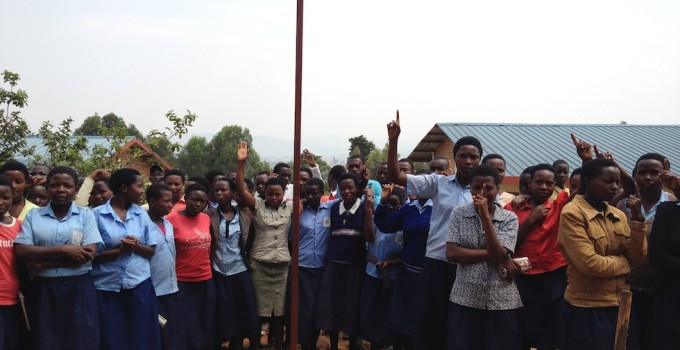
When the program first began, Ataman documented a recording session in a Rwandan school with children 13-14 years of age. The children sang songs based on heavy subject matter such as AIDS, slavery, poverty, loving their body, and a lack of opportunities involving education. Another artist, who joined the program in Bukavu in the DRC is Sandra. She wrote the song “My Body is Not a Weapon” in the French language which I had the joy of listening to during the guest lecture. I am amazed by Sandra’s story because being an orphan at the age of 15 she was raped, “became pregnant, miscarried her child, and discovered she was HIV positive upon arriving at Panzi Hospital in Bukavu.” (Ataman, Quantifiable Proof: Healing in Harmony). Ataman further explained, “She endured years of surgery to physically heal before entering into our program to heal psychologically and emotionally.” (Ataman, Quantifiable Proof: Healing in Harmony). Alongside Sandra at a concert held by the Panzi foundation in Bukavu partnered with Make Music Matter, 16-year old artist Etoile, also sang “My Body is Not a Weapon” (Ataman, Quantifiable Proof: Healing in Harmony). Furthermore, “… Etoile has two children born of rape. The eldest lives with her grandmother, the youngest lives with her. This innocent child served as a constant reminder of the rapes, and Etoile struggled with detachment.” (Ataman, Quantifiable Proof: Healing in Harmony). Following the performance, the crowd responded with a roar of applause and witnessing this, Ataman watched as Etoile kissed her baby. (Ataman, Quantifiable Proof: Healing in Harmony). Ataman stated, “This embrace was the first time that she demonstrated an attachment to her child. Her body was hers again, reclaimed through the transformative power of music.” (Ataman, Quantifiable Proof: Healing in Harmony). Overall, these stories of women overcoming their traumatic experiences demonstrates resilience and by sharing these stories they continue to empower all victims of abuse.
Knowingly, the areas where Ataman has based his work are high-deficit conflict zones. In his presentation he noted that he has an armed security force hired to protect him because there are roughly 1-3 attacks in the Congo per week. He also explained that when driving through conflict, if he sees someone hurt, his instinct is to help them. However, the driver must follow protocol by not stopping in order to protect him among others in the car.
Although, the organization proves that it makes a positive impact for many victims of sexual violence, the job is not easy. Ataman has described countless shootings occurring in his wake, however his work is crucial even though it exposes him to dangerous situations. Ataman notes, “Our team of providers quickly learned how truly helpless one is in conflict and war.” (Ataman, Quantifiable Proof: Healing in Harmony). For example, while in Bukavu in May 2017, a protest broke out in the streets because a beloved neighborhood couple had just been assassinated. Ataman and his team were en route to a facility and had to find a safe place to hide while the “government forces utilized live ammunition to suppress civilians” (Ataman, Confronting Hypocrisy on the Frontlines).
Another incident occurred in 2011 when Ataman was filming a documentary in Jonglei, South Sudan on a citizen from the country who now lives in Canada (Ataman, Confronting Hypocrisy on the Frontlines). While passing by child soldiers at “manned arbitrary border crossings”, he witnessed military men assaulting women from a distance and was told to look away as the car kept driving through (Ataman, Confronting Hypocrisy on the Frontlines). As described by Ataman, “To this day I am achingly uncertain whether it would have been better to intervene to try and save one person or certify the completion of the documentary.” (Ataman, Confronting Hypocrisy on the Frontlines). Ataman and his colleagues continue to undergo tales of escape, forced migration and resettlement due to the violent conditions (Ataman, Confronting Hypocrisy on the Frontlines). The quote below reveals how these difficult decisions are beyond easy to make and that it often comes down to the question: how can we help others in conflict zones whilst protecting our own safety?
“On the frontlines, evaluating program effectiveness, or looking for new projects to implement, often leads to binary choices. Who lives? Who is left behind? Which community is safer? Within these equations where human rights defenders and champions work, the choices often feel like a grotesque adaptation of Sophie’s Choice.” – Darcy Ataman
Overall, his work is based on the notion that sexual violence against women is a human rights violation and by starting the Make Music Matter organization, he has gained a greater sense of respect and openness for the people living in these communities. I think this is something that takes time because often people may go into an area believing they can ‘save everyone’ and they do not fully understand the community, the impact of certain circumstances, and the history hidden behind the conflict. Ataman is very conscious of what he is doing and has completed an act of agency by leaving his job producing to bring change to another part of the world. Ataman ended his presentation by stating how anyone can make an impact by allowing their ideas to snowball into something successful and with the release of the music produced through the program, awareness continues to transform thousands of lives.
Written by Tessa R. Adamski
Bibliography
Adetunji, Jo. Forty-eight women raped every hour in Congo, study finds . 12 May 2011. Article . 22 November 2017.
Ataman, Darcy. Confronting Hypocrisy on the Frontlines. 27 May 2017. Article. 14 November 2017.
—. Quantifiable Proof: Healing in Harmony. 3 April 2017. Article. 14 November 2017.
Bradley, Megan. Sexual and Gender-based Violence in the Democratic Republic of the Congo: Opportunities for Progress as M23 Disarms? 13 November 2013. Website. 22 November 2017.
Make Music Matter. Make Music Matter. 2013. Website. 15 November 2017.
Make Music Matter in Rwanda. 2013. Make Music Matter, n.p.
Other information gathered from an in-class discussion
 Life in Colour
0 comments on “Make Music Matter: An Organization Helping Victims of Sexual Violence”